

-
21 lower
I transitive verb1) (let down) herab-/hinablassen; einholen [Flagge, Segel]lower oneself into — hinuntersteigen in (+ Akk.) [Kanalschacht, Keller]
lower oneself into a chair — sich in einen Sessel sinken lassen
2) (reduce in height) senken [Blick]; niederschlagen [Augen]; absenken [Zimmerdecke]; auslassen [Saum]3) (lessen) senken [Preis, Miete, Zins usw.]4) (degrade) herabsetzenlower oneself to do something — sich so weit erniedrigen, etwas zu tun
5) (weaken) schwächen; dämpfen [Licht, Stimme, Lärm]II 1. comparative adjectivelower one's voice — leiser sprechen; die Stimme senken (geh.)
1) unter... [Nil, Themse usw., Atmosphäre]; Unter[jura, -devon usw., -arm, -lippe usw.]; Nieder[rhein, -kalifornien]2) (in rank) unter...lower mammals/plants — niedere Säugetiere/Pflanzen
2. comparative adverbthe lower orders/classes — die Unterschichten/die unteren Klassen
tiefer [sinken, hängen usw.]* * *1) (to make or become less high: She lowered her voice.) senken2) (to let down: He lowered the blinds.) herunterlassen* * *low·er1[ˈləʊəʳ, AM ˈloʊɚ]in the \lower back im unteren Rücken\lower floor untere Etage\lower jaw Unterkiefer m\lower lip Unterlippe fthe \lower reaches of the ocean die tieferen Regionen des Ozeansthe L\lower Rhine GEOG der NiederrheinII. vt1. (move downward)▪ to \lower sth etw herunterlassen▪ to \lower oneself:she \lowered herself into a chair sie ließ sich auf einem Stuhl niederthe miners \lowered themselves into the tunnel die Bergleute ließen sich in den Stollen hinunterto \lower one's arm/hands den Arm/die Hände senkento \lower one's eyes die Augen niederschlagen, den Blick senkento \lower one's head den Kopf senkento \lower a flag/the sails eine Fahne/die Segel einholento \lower the hem den Saum herauslassento \lower the landing gear das Fahrgestell ausfahrento \lower a lifeboat NAUT ein Rettungsboot zu Wasser lassen [o aussetzen]to \lower the periscope das Periskop einfahren2. (decrease)▪ to \lower sth etw verringern [o senken]his crude jokes \lowered the tone of the evening seine derben Witze drückten das Niveau des Abendsto \lower one's expectations/sights seine Erwartungen/Ansprüche zurückschraubento \lower one's guard seine Deckung vernachlässigento \lower the heat die Temperatur zurückdrehento \lower interest rates die Zinssätze senkento \lower prices/taxes die Preise/Steuern senkento \lower the quality die Qualität mindernto \lower one's voice seine Stimme senkento \lower one's standards seine Anforderungen zurückschrauben3. (demean)I wouldn't \lower myself to respond to his insults ich würde mich nicht auf sein Niveau begeben und auf seine Beleidigungen antwortenI'd never have expected him to \lower himself by stealing ich hätte nie gedacht, dass er so tief sinken könnte und stehlen würdelow·er2[laʊəʳ, AM laʊr]▪ to \lower at sb jdn finster ansehen* * *I ['ləʊə(r)]1. adj1) (in height) niedriger; part, half, limb, storey, latitude untere(r, s); note tiefer; (GEOG) Nieder-lower leg/arm — Unterschenkel m/-arm m
lower jaw/lip — Unterkiefer m/-lippe
hemlines are lower this year — die Röcke sind dieses Jahr länger
the lower deck (of bus) — das untere Deck; (of ship) das Unterdeck
a lower middle-class family — eine Familie aus der unteren Mittelschicht
the lower school — die unteren Klassen, die Unter- und Mittelstufe
See:→ lower sixth (form)2. advtiefer, leiser3. vt1) (= let down) boat, injured man, load herunterlassen; eyes, gun senken; mast umlegen; sail, flag einholen; bicycle saddle niedriger machen"lower the lifeboats!" —
"lower away!" — " holt ein!"
2) (= reduce) pressure, risk verringern; price, interest rates, cost, tone, temperature senken; morale, resistance schwächen; standard herabsetzenthat is no excuse for lowering the standards of service — das ist keine Entschuldigung dafür, den Service zu verschlechtern
to lower oneself — sich hinunterlassen; (socially) sich unter sein Niveau begeben
to lower oneself to do sth — sich herablassen, etw zu tun
4. visinken, fallen II ['laʊə(r)]viSee:= academic.ru/43910/lour">lour* * *lower1 [ˈlaʊə(r)] v/i1. finster oder drohend blicken:lower at sb jemanden finster oder drohend ansehenb) sich mit schwarzen Wolken überziehen (Himmel)lower2 [ˈləʊə(r)]A v/t1. eine Mauer etc niedriger machen2. die Augen, den Gewehrlauf etc, auch die Stimme, den Preis, die Temperatur etc senken, das Wahlalter etc auch herabsetzen3. fig erniedrigen:lower o.s.a) sich demütigen,b) sich herablassen4. abschwächen, mäßigen:lower one’s hopes seine Hoffnungen herabschrauben5. herunter-, herab-, niederlassen, FLUG das Fahrgestell ausfahren, eine Fahne, ein Segel niederholen, streichen; → flag1 A 1B v/i1. niedriger werden (auch fig)2. fig sinken, heruntergehen, fallenlower3 [ˈləʊə(r)]A komp von low1 AB adj1. niedriger (auch fig):a lower estimate eine niedrigere Schätzung2. unter(er, e, es), Unter…:3. GEOG Unter…, Nieder…:Lower Austria Niederösterreich n4. neuer, jünger (Datum):of a lower date jüngeren Datums5. BIOL nieder (Pflanzen etc)* * *I transitive verb1) (let down) herab-/hinablassen; einholen [Flagge, Segel]lower oneself into — hinuntersteigen in (+ Akk.) [Kanalschacht, Keller]
2) (reduce in height) senken [Blick]; niederschlagen [Augen]; absenken [Zimmerdecke]; auslassen [Saum]3) (lessen) senken [Preis, Miete, Zins usw.]4) (degrade) herabsetzenlower oneself to do something — sich so weit erniedrigen, etwas zu tun
5) (weaken) schwächen; dämpfen [Licht, Stimme, Lärm]II 1. comparative adjectivelower one's voice — leiser sprechen; die Stimme senken (geh.)
1) unter... [Nil, Themse usw., Atmosphäre]; Unter[jura, -devon usw., -arm, -lippe usw.]; Nieder[rhein, -kalifornien]2) (in rank) unter...lower mammals/plants — niedere Säugetiere/Pflanzen
2. comparative adverbthe lower orders/classes — die Unterschichten/die unteren Klassen
tiefer [sinken, hängen usw.]* * *adj.ausfahren (Fahrgestell) adj.klein adj.unterer adj. v.absenken (Grundwasserspiegel) v.niederlassen v. -
22 signal
1) сигнал || сигнализировать || сигнальный2) сигнальное устройство, устройство сигнализации•- accumulating signalsto emit an alarm signal — подавать аварийный сигнал; подавать сигнал неисправности, подавать сигнал о неисправности
- acknowledgement signal
- action feedback signal
- actuating error signal
- actuating signal
- actuation signal
- actuator drive signal
- AE power signal
- AE signal
- alarm signal
- analog probe head signal
- analog signal
- audible signal
- auxiliary function completion signal
- axis designation signal
- binary signal
- blanking signal
- brake-off signal
- brake-on signal
- break signal
- bulk wave signals
- chrominance signal
- classifying signal
- coincidence signal
- collet-closed signal
- collet-open signal
- collision signal
- color difference signal
- color synchronizing signal
- command signal
- composite color signal
- composite picture signal
- composite video signal
- confirmation signal
- contact detection signal
- continuous signal
- control instruction signal
- control signal
- converted signal
- coordinate signal
- correction signal
- corrective signal
- current speed signal
- cutoff signal
- cutting load signal
- decrease signal
- demand signal
- detection signal
- digital signal
- discharge-classifying signal
- disturbance signal
- disturbing signal
- drive signal
- emergency signal
- emission signal
- end-of-block signal
- erase signal
- error signal
- excitation signal
- fall signal
- feed stop signal
- feedback control signal
- feedback data signal
- feedback loop signal
- feedback signal
- feedthrough signal
- flaw signal
- forward signal
- guidance signal
- halt signal
- high-level signal
- historical signal
- increase signal
- indicative signal
- in-position signal
- input signal
- interfering signal
- IR light signal
- low-level signal
- luminance signal
- manipulation signal
- measuring signal
- miscellaneous function signal
- model signal
- monitored signal
- monitoring signal
- motion signal
- multiplexed signal
- noisy signal
- numerical signal
- off-on signal
- OK signal
- on/off signals
- once-per-revolution signal
- output signal
- pass signal
- phase reference signal
- phase-modulation signal
- pick-off signal
- pilot signal
- position command signal
- position error signal
- position-indicating signal
- position-instructing signal
- power signal
- pressure feedback signal
- probe's signal
- program signal
- protection signal
- pull signal
- pulse signal
- PWM signal
- qualification microrpocessor signal
- quantized control signal
- random signal
- reference signal
- reference voltage signal
- reference-input signal
- reflected beam signal
- reject signal
- relevant signal
- retract signal
- return signal
- sensing signal
- set-point signal
- signal of control system
- signal of electromagnetic interference
- skip signal
- slow-down signal
- sonic signal
- sound signal
- SPC signals
- spurious signal
- square wave signal
- start signal
- starting signal
- statistical signals
- stop signal
- stopping signal
- switch signal
- synchronizing signal
- tailstock-in-position signal
- tape reference signal
- test signal
- tool change signal
- touch signal
- trigger signal
- trouble signal
- velocity feedback signal
- velocity signal
- video signal
- warning signal
- worn-tool signal
- X signal
- Y signalEnglish-Russian dictionary of mechanical engineering and automation > signal
-
23 drop
1. n слезинка; капля крови; капелька потаprint drop — капля, образующая печатное изображение
2. n капля, капелька; чуточка; глоток3. n глоток спиртногоto have a drop too much — хватить лишнего, напиться
4. n мед. капли5. n драже; леденецpear drop — грушевидный леденец; леденец на грушевой эссенции
6. n серьга; подвеска; висюлька7. n архит. орнаментная отделка в виде подвески8. n падение, понижение, снижение; спад, спуск9. n спад10. n ав. разбрасывание, сбрасывание с самолёта; сбрасывание на парашюте11. n ав. десантparatroop drop — авиадесант, парашютный десант
12. n ав. расстояние сверху вниз, высота; обрыв; глубина падения или погруженияact drop — занавес, опускаемый между действиями или сценами
13. n ав. опускающаяся подставка14. n ав. падающее устройство, падающая дверца, трап15. n ав. пластинка, закрывающая замочную скважину16. n ав. прорезь, щель17. n ав. тех. перепад; падение18. n ав. результат поиска, выдачаto drop a case — отказаться от иска, от обвинения
19. n ав. сл. тайник20. n ав. амер. сл. круглый сирота; беспризорник21. v капать; стекать каплями22. v капать, выпускать по капле23. v падать, выпадать; вываливатьсяdrop to — падать до; спускаться до
24. v ронять, выпускать25. v бросать, сбрасывать; спускать26. v спускать или сбрасывать на парашюте27. v падать, опускатьсяto be ready to drop — валиться с ног от усталости, выбиться из сил
drop out — опускать, выпускать, пропускать
28. v валить, сваливать; сшибать, сбивать29. v умирать30. v падать, снижаться, понижаться; спадать, стихать31. v снижать, понижать32. v идти вниз33. v падать с определённой высоты34. v мор. погружаться вертикально35. v опускаться36. v спорт. посылать, забивать37. v спускаться, идти вниз по течению38. v спускать по течению39. v отступать назадdrop back — отступать; отходить
40. v оставлять сзади, обгонять41. v спорт. передавать назад42. v разг. кончаться, подходить к концу; прекращаться43. v разг. кончать, прекращать44. v разг. оставлять, бросать45. v разг. распускать46. v разг. опускать, пропускатьСинонимический ряд:1. decline (noun) abyss; decline; declivity; decrease; descent; dip; dive; downslide; downswing; downtrend; downturn; drop-off; fall; falloff; lowering; plunge; precipice; reduction; sag; skid; slide; slip; slump; tumble2. depth (noun) deepness; depth3. dram (noun) dollop; dram; jolt; nip; shot; sip; slug; snifter; snort; snorter; spot; toothful; tot4. droplet (noun) bead; drib; driblet; droplet; globule; gobbet; tear5. particle (noun) ace; atom; bit; crumb; dab; damn; dash; doit; fragment; grain; hoot; iota; jot; minim; mite; modicum; molecule; ounce; particle; pinch; ray; scrap; scruple; shred; smidgen; smitch; snap; speck; splash; syllable; tittle; trace; whit6. trickle (noun) dribble; drip; trickle7. abandon (verb) abandon; forsake; leave8. cancel (verb) call off; cancel; scrub9. collapse (verb) break down; cave in; collapse; crack; give out; peg out; succumb; wilt10. die (verb) cash in; conk; decease; demise; depart; die; expire; go; pass; pass away; pass out; perish; pip; pop off11. diminish (verb) diminish; dwindle; lessen12. discard (verb) discard; release13. dismiss (verb) ax; boot out; bounce; cashier; discharge; disemploy; dismiss; fire; give over; give up; kick out; let out; sack; skip; turn off14. drip (verb) distil; distill; drib; dribble; drip; leap; ooze; trickle; trill; weep15. fall (verb) decline; descend; dip; dive; fall; fall off; go down; keel over; nose-dive; pitch; plummet; plunge; sink; skid; slump; spill; sprawl; tumble16. fell (verb) bowl down; bowl over; bring down; cut down; deck; down; fell; flatten; floor; ground; knock down; knock over; lay low; level; mow down; prostrate; throw; throw down; topple17. lose (verb) forfeit; lose; lose out; sacrifice18. lower (verb) depress; let down; lower; take down19. quit (verb) quit; resign; terminate20. remove (verb) delete; eliminate; exclude; omit; remove21. separate (verb) break off; desert; divorce; end; separateАнтонимический ряд:abundance; climb; continue; empty; evaporate; flood; flow; include; increase; pick up; pour; pursue; rally; recover; rise; soar -
24 double fault to earth
двойное замыкание на землю
Совокупность двух однофазных замыканий на землю в различных, но электрически связанных частях электроустановки
[ ГОСТ 26522-85]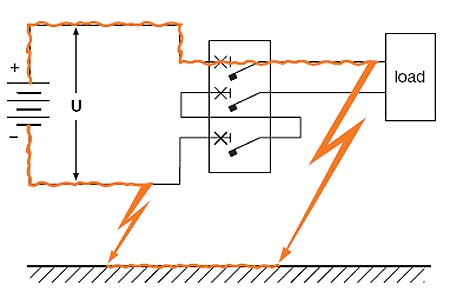
Рис. ABB
Двойное замыкание на землю в сети, изолированной от земли
(Double fault in a network insulated from earth)Параллельные тексты EN-RU
The possibility of a double fault to earth (the first fault on the supply side of the poles of one polarity an the second one on the load side of the poles of the other polarity) is not considered, therefore it is suggested the use of a device to monitor the insulation to earth, capable of signaling the decrease of the insulation to earth as a consequence of a first fault to earth
[ABB]Возможность двойного замыкания на землю (первое – замыкание одного из полюсов сети со стороны источника питания, второе – замыкание другого полюса со стороны нагрузки) не рассматривается. Однако предлагается использовать устройство контроля изоляции сети относительно земли. Это устройство должно сигнализировать об ухудшении изоляции сети электроустановки относительно земли при первом замыкании на землю.
[Перевод Интент]Тематики
Классификация
>>>EN
Англо-русский словарь нормативно-технической терминологии > double fault to earth
-
25 DOL
- эффект операционного рычага
- пускатель прямого действия
- прямой пуск вращающегося электродвигателя
- Министерство труда (США)
- концентрация растворённого кислорода
концентрация растворённого кислорода
—
[А.С.Гольдберг. Англо-русский энергетический словарь. 2006 г.]Тематики
EN
Министерство труда (США)
—
[А.С.Гольдберг. Англо-русский энергетический словарь. 2006 г.]Тематики
EN
прямой пуск вращающегося электродвигателя
Пуск вращающегося электродвигателя путем непосредственного подключения его к питающей сети.
[ ГОСТ 27471-87]EN
direct-on-line starting
across-the-line starting (US)
the process of starting a motor by connecting it directly to the supply at rated voltage
[IEV number 411-52-15]FR
démarrage direct
mode de démarrage d'un moteur, consistant à lui appliquer directement sa pleine tension assignée
[IEV number 411-52-15]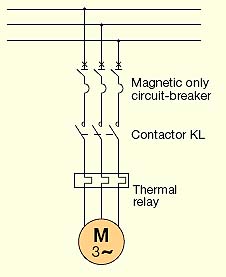
Рис. ABB
Схема прямого пуска электродвигателяMagnetic only circuit-breaker - Автоматический выключатель с электромагнитным расцепителем
Contactor KL - Контактор KL
Thermal relay - Тепловое реле
Параллельные тексты EN-RU
Direct-on-line starting
Direct-on-line starting, which is often abbreviated as DOL, is perhaps the most traditional system and consists in connecting the motor directly to the supply network, thus carrying out starting at full voltage.Direct-on-line starting represents the simplest and the most economical system to start a squirrel-cage asynchronous motor and it is the most used.
As represented in Figure 5, it provides the direct connection to the supply network and therefore starting is carried out at full voltage and with constant frequency, developing a high starting torque with very reduced acceleration times.
The typical applications are relevant to small power motors also with full load starting.
These advantages are linked to some problems such as, for example, the high inrush current, which - in the first instants - can reach values of about 10 to 12 times the rated current, then can decrease to about 6 to 8 times the rated current and can persist to reach the maximum torque speed.The effects of such currents can be identified with the high electro-dynamical stresses on the motor connection cables and could affect also the windings of the motor itself; besides, the high inrush torques can cause violent accelerations which stress the transmission components (belts and joints) generating distribution problems with a reduction in the mechanical life of these elements.
Finally, also the possible electrical problems due to voltage drops on the supply line of the motor or of the connected equipment must be taken into consideration.
[ABB]Прямой пуск
Прямой пуск, который по-английски часто сокращенно обозначают как DOL, является, пожалуй наиболее распространенным способом пуска. Он заключается в непосредственном (т. е. прямом) подключении двигателя к питающей сети. Это означает, что пуск двигателя осуществляется при полном напряжении.Схема прямого пуска является наиболее простым, экономичным и чаще всего применяемым решением для электродвигателей с короткозамкнутым ротором.
Схема прямого подключения к сети представлена на рисунке 5. Пуск осуществляется при полном напряжении и постоянной частоте сети. Электродвигатель развивает высокий пусковой момент при коротком времени разгона.
Типичные области применения – маломощные электродвигатели, в том числе с пуском при полной нагрузке.
Однако, наряду с преимуществами имеются и определенные недостатки, например, бросок пускового тока, достигающий в первоначальный момент 10…12-кратного значения от номинального тока электродвигателя. Затем ток двигателя уменьшается примерно до 6…8-кратного значения номинального тока и будет держаться на этом уровне до тех пор, пока скорость двигателя не достигнет максимального значения.
Такое изменение тока оказывает значительное электродинамическое воздействие на кабель, подключенный к двигателю. Кроме того пусковой ток воздействует на обмотки двигателя. Высокий начальный пусковой момент может привести к значительному ускорению и следовательно к значительной нагрузке элементов привода (ремней, крепления узлов), что вызывает сокращение их срока службы.
И, наконец, следует принять во внимание возможное возникновение проблем, связанных с падением напряжения в линии питания двигателя и подключенного к этой линии оборудования.
[Перевод Интент]
Тематики
Синонимы
EN
- across-the-line starting (US)
- direct line starting
- direct operation of a motor
- direct starting
- direct-on-line starting
- DOL
- full voltage starter application
DE
FR
пускатель прямого действия
Пускатель, одноступенчато подающий сетевое напряжение на выводы двигателя.
(МЭС 441-14-40)
[ ГОСТ Р 50030.4.1-2002 (МЭК 60947-4-1-2000)]
Пускатели переменного тока для прямого непосредственного пуска (с полным напряжением)
Пускатели, предназначенные для пуска двигателя, разгона его до номинальной скорости, защиты двигателя и подключенных к нему цепей от рабочих перегрузок и отключения питания двигателя.
[ ГОСТ Р 50030.4.1-2002 (МЭК 60947-4-1-2000)]EN
direct-on-line starter
a starter which connects the line voltage across the motor terminals in one step
[IEV number 441-14-40]FR
démarreur direct
démarreur qui applique la tension d'alimentation sur les bornes du moteur en une seule manoeuvre
[IEV number 441-14-40]Параллельные тексты EN-RU
Direct-on-line starters
Starters which connect the line voltage across the motor terminals in one step, intended to start and accelerate a motor to normal speed.
They shall ensure switching and protection functions as prescribed in the general definition.
[ABB]Пускатели прямого действия
Пускатели, одноступенчато подающие сетевое напряжение на зажимы двигателя и предназначенные для его пуска и разгона до номинальной скорости.
Кроме того, они должны обеспечивать коммутацию и защиту в соответствии с общим определением.
[Перевод Интент]Тематики
EN
DE
FR
эффект операционного рычага
эффект производственного рычага
Эффект операционного рычага - выражение того факта, что любое изменение выручки от реализации порождает изменение прибыли. Сила воздействия операционного рычага вычисляется как частное от деления выручки от реализации после возмещения переменных затрат на прибыль.
[ http://www.lexikon.ru/dict/fin/a.html]Тематики
Синонимы
EN
Англо-русский словарь нормативно-технической терминологии > DOL
-
26 direct starting
прямой пуск
—
[Я.Н.Лугинский, М.С.Фези-Жилинская, Ю.С.Кабиров. Англо-русский словарь по электротехнике и электроэнергетике, Москва, 1999 г.]Тематики
- электротехника, основные понятия
EN
прямой пуск вращающегося электродвигателя
Пуск вращающегося электродвигателя путем непосредственного подключения его к питающей сети.
[ ГОСТ 27471-87]EN
direct-on-line starting
across-the-line starting (US)
the process of starting a motor by connecting it directly to the supply at rated voltage
[IEV number 411-52-15]FR
démarrage direct
mode de démarrage d'un moteur, consistant à lui appliquer directement sa pleine tension assignée
[IEV number 411-52-15]
Рис. ABB
Схема прямого пуска электродвигателяMagnetic only circuit-breaker - Автоматический выключатель с электромагнитным расцепителем
Contactor KL - Контактор KL
Thermal relay - Тепловое реле
Параллельные тексты EN-RU
Direct-on-line starting
Direct-on-line starting, which is often abbreviated as DOL, is perhaps the most traditional system and consists in connecting the motor directly to the supply network, thus carrying out starting at full voltage.Direct-on-line starting represents the simplest and the most economical system to start a squirrel-cage asynchronous motor and it is the most used.
As represented in Figure 5, it provides the direct connection to the supply network and therefore starting is carried out at full voltage and with constant frequency, developing a high starting torque with very reduced acceleration times.
The typical applications are relevant to small power motors also with full load starting.
These advantages are linked to some problems such as, for example, the high inrush current, which - in the first instants - can reach values of about 10 to 12 times the rated current, then can decrease to about 6 to 8 times the rated current and can persist to reach the maximum torque speed.The effects of such currents can be identified with the high electro-dynamical stresses on the motor connection cables and could affect also the windings of the motor itself; besides, the high inrush torques can cause violent accelerations which stress the transmission components (belts and joints) generating distribution problems with a reduction in the mechanical life of these elements.
Finally, also the possible electrical problems due to voltage drops on the supply line of the motor or of the connected equipment must be taken into consideration.
[ABB]Прямой пуск
Прямой пуск, который по-английски часто сокращенно обозначают как DOL, является, пожалуй наиболее распространенным способом пуска. Он заключается в непосредственном (т. е. прямом) подключении двигателя к питающей сети. Это означает, что пуск двигателя осуществляется при полном напряжении.Схема прямого пуска является наиболее простым, экономичным и чаще всего применяемым решением для электродвигателей с короткозамкнутым ротором.
Схема прямого подключения к сети представлена на рисунке 5. Пуск осуществляется при полном напряжении и постоянной частоте сети. Электродвигатель развивает высокий пусковой момент при коротком времени разгона.
Типичные области применения – маломощные электродвигатели, в том числе с пуском при полной нагрузке.
Однако, наряду с преимуществами имеются и определенные недостатки, например, бросок пускового тока, достигающий в первоначальный момент 10…12-кратного значения от номинального тока электродвигателя. Затем ток двигателя уменьшается примерно до 6…8-кратного значения номинального тока и будет держаться на этом уровне до тех пор, пока скорость двигателя не достигнет максимального значения.
Такое изменение тока оказывает значительное электродинамическое воздействие на кабель, подключенный к двигателю. Кроме того пусковой ток воздействует на обмотки двигателя. Высокий начальный пусковой момент может привести к значительному ускорению и следовательно к значительной нагрузке элементов привода (ремней, крепления узлов), что вызывает сокращение их срока службы.
И, наконец, следует принять во внимание возможное возникновение проблем, связанных с падением напряжения в линии питания двигателя и подключенного к этой линии оборудования.
[Перевод Интент]
Тематики
Синонимы
EN
- across-the-line starting (US)
- direct line starting
- direct operation of a motor
- direct starting
- direct-on-line starting
- DOL
- full voltage starter application
DE
FR
Англо-русский словарь нормативно-технической терминологии > direct starting
-
27 across-the-line starting (US)
прямой пуск вращающегося электродвигателя
Пуск вращающегося электродвигателя путем непосредственного подключения его к питающей сети.
[ ГОСТ 27471-87]EN
direct-on-line starting
across-the-line starting (US)
the process of starting a motor by connecting it directly to the supply at rated voltage
[IEV number 411-52-15]FR
démarrage direct
mode de démarrage d'un moteur, consistant à lui appliquer directement sa pleine tension assignée
[IEV number 411-52-15]
Рис. ABB
Схема прямого пуска электродвигателяMagnetic only circuit-breaker - Автоматический выключатель с электромагнитным расцепителем
Contactor KL - Контактор KL
Thermal relay - Тепловое реле
Параллельные тексты EN-RU
Direct-on-line starting
Direct-on-line starting, which is often abbreviated as DOL, is perhaps the most traditional system and consists in connecting the motor directly to the supply network, thus carrying out starting at full voltage.Direct-on-line starting represents the simplest and the most economical system to start a squirrel-cage asynchronous motor and it is the most used.
As represented in Figure 5, it provides the direct connection to the supply network and therefore starting is carried out at full voltage and with constant frequency, developing a high starting torque with very reduced acceleration times.
The typical applications are relevant to small power motors also with full load starting.
These advantages are linked to some problems such as, for example, the high inrush current, which - in the first instants - can reach values of about 10 to 12 times the rated current, then can decrease to about 6 to 8 times the rated current and can persist to reach the maximum torque speed.The effects of such currents can be identified with the high electro-dynamical stresses on the motor connection cables and could affect also the windings of the motor itself; besides, the high inrush torques can cause violent accelerations which stress the transmission components (belts and joints) generating distribution problems with a reduction in the mechanical life of these elements.
Finally, also the possible electrical problems due to voltage drops on the supply line of the motor or of the connected equipment must be taken into consideration.
[ABB]Прямой пуск
Прямой пуск, который по-английски часто сокращенно обозначают как DOL, является, пожалуй наиболее распространенным способом пуска. Он заключается в непосредственном (т. е. прямом) подключении двигателя к питающей сети. Это означает, что пуск двигателя осуществляется при полном напряжении.Схема прямого пуска является наиболее простым, экономичным и чаще всего применяемым решением для электродвигателей с короткозамкнутым ротором.
Схема прямого подключения к сети представлена на рисунке 5. Пуск осуществляется при полном напряжении и постоянной частоте сети. Электродвигатель развивает высокий пусковой момент при коротком времени разгона.
Типичные области применения – маломощные электродвигатели, в том числе с пуском при полной нагрузке.
Однако, наряду с преимуществами имеются и определенные недостатки, например, бросок пускового тока, достигающий в первоначальный момент 10…12-кратного значения от номинального тока электродвигателя. Затем ток двигателя уменьшается примерно до 6…8-кратного значения номинального тока и будет держаться на этом уровне до тех пор, пока скорость двигателя не достигнет максимального значения.
Такое изменение тока оказывает значительное электродинамическое воздействие на кабель, подключенный к двигателю. Кроме того пусковой ток воздействует на обмотки двигателя. Высокий начальный пусковой момент может привести к значительному ускорению и следовательно к значительной нагрузке элементов привода (ремней, крепления узлов), что вызывает сокращение их срока службы.
И, наконец, следует принять во внимание возможное возникновение проблем, связанных с падением напряжения в линии питания двигателя и подключенного к этой линии оборудования.
[Перевод Интент]
Тематики
Синонимы
EN
- across-the-line starting (US)
- direct line starting
- direct operation of a motor
- direct starting
- direct-on-line starting
- DOL
- full voltage starter application
DE
FR
Англо-русский словарь нормативно-технической терминологии > across-the-line starting (US)
-
28 direct line starting
прямой пуск вращающегося электродвигателя
Пуск вращающегося электродвигателя путем непосредственного подключения его к питающей сети.
[ ГОСТ 27471-87]EN
direct-on-line starting
across-the-line starting (US)
the process of starting a motor by connecting it directly to the supply at rated voltage
[IEV number 411-52-15]FR
démarrage direct
mode de démarrage d'un moteur, consistant à lui appliquer directement sa pleine tension assignée
[IEV number 411-52-15]
Рис. ABB
Схема прямого пуска электродвигателяMagnetic only circuit-breaker - Автоматический выключатель с электромагнитным расцепителем
Contactor KL - Контактор KL
Thermal relay - Тепловое реле
Параллельные тексты EN-RU
Direct-on-line starting
Direct-on-line starting, which is often abbreviated as DOL, is perhaps the most traditional system and consists in connecting the motor directly to the supply network, thus carrying out starting at full voltage.Direct-on-line starting represents the simplest and the most economical system to start a squirrel-cage asynchronous motor and it is the most used.
As represented in Figure 5, it provides the direct connection to the supply network and therefore starting is carried out at full voltage and with constant frequency, developing a high starting torque with very reduced acceleration times.
The typical applications are relevant to small power motors also with full load starting.
These advantages are linked to some problems such as, for example, the high inrush current, which - in the first instants - can reach values of about 10 to 12 times the rated current, then can decrease to about 6 to 8 times the rated current and can persist to reach the maximum torque speed.The effects of such currents can be identified with the high electro-dynamical stresses on the motor connection cables and could affect also the windings of the motor itself; besides, the high inrush torques can cause violent accelerations which stress the transmission components (belts and joints) generating distribution problems with a reduction in the mechanical life of these elements.
Finally, also the possible electrical problems due to voltage drops on the supply line of the motor or of the connected equipment must be taken into consideration.
[ABB]Прямой пуск
Прямой пуск, который по-английски часто сокращенно обозначают как DOL, является, пожалуй наиболее распространенным способом пуска. Он заключается в непосредственном (т. е. прямом) подключении двигателя к питающей сети. Это означает, что пуск двигателя осуществляется при полном напряжении.Схема прямого пуска является наиболее простым, экономичным и чаще всего применяемым решением для электродвигателей с короткозамкнутым ротором.
Схема прямого подключения к сети представлена на рисунке 5. Пуск осуществляется при полном напряжении и постоянной частоте сети. Электродвигатель развивает высокий пусковой момент при коротком времени разгона.
Типичные области применения – маломощные электродвигатели, в том числе с пуском при полной нагрузке.
Однако, наряду с преимуществами имеются и определенные недостатки, например, бросок пускового тока, достигающий в первоначальный момент 10…12-кратного значения от номинального тока электродвигателя. Затем ток двигателя уменьшается примерно до 6…8-кратного значения номинального тока и будет держаться на этом уровне до тех пор, пока скорость двигателя не достигнет максимального значения.
Такое изменение тока оказывает значительное электродинамическое воздействие на кабель, подключенный к двигателю. Кроме того пусковой ток воздействует на обмотки двигателя. Высокий начальный пусковой момент может привести к значительному ускорению и следовательно к значительной нагрузке элементов привода (ремней, крепления узлов), что вызывает сокращение их срока службы.
И, наконец, следует принять во внимание возможное возникновение проблем, связанных с падением напряжения в линии питания двигателя и подключенного к этой линии оборудования.
[Перевод Интент]
Тематики
Синонимы
EN
- across-the-line starting (US)
- direct line starting
- direct operation of a motor
- direct starting
- direct-on-line starting
- DOL
- full voltage starter application
DE
FR
Англо-русский словарь нормативно-технической терминологии > direct line starting
-
29 direct operation of a motor
прямой пуск вращающегося электродвигателя
Пуск вращающегося электродвигателя путем непосредственного подключения его к питающей сети.
[ ГОСТ 27471-87]EN
direct-on-line starting
across-the-line starting (US)
the process of starting a motor by connecting it directly to the supply at rated voltage
[IEV number 411-52-15]FR
démarrage direct
mode de démarrage d'un moteur, consistant à lui appliquer directement sa pleine tension assignée
[IEV number 411-52-15]
Рис. ABB
Схема прямого пуска электродвигателяMagnetic only circuit-breaker - Автоматический выключатель с электромагнитным расцепителем
Contactor KL - Контактор KL
Thermal relay - Тепловое реле
Параллельные тексты EN-RU
Direct-on-line starting
Direct-on-line starting, which is often abbreviated as DOL, is perhaps the most traditional system and consists in connecting the motor directly to the supply network, thus carrying out starting at full voltage.Direct-on-line starting represents the simplest and the most economical system to start a squirrel-cage asynchronous motor and it is the most used.
As represented in Figure 5, it provides the direct connection to the supply network and therefore starting is carried out at full voltage and with constant frequency, developing a high starting torque with very reduced acceleration times.
The typical applications are relevant to small power motors also with full load starting.
These advantages are linked to some problems such as, for example, the high inrush current, which - in the first instants - can reach values of about 10 to 12 times the rated current, then can decrease to about 6 to 8 times the rated current and can persist to reach the maximum torque speed.The effects of such currents can be identified with the high electro-dynamical stresses on the motor connection cables and could affect also the windings of the motor itself; besides, the high inrush torques can cause violent accelerations which stress the transmission components (belts and joints) generating distribution problems with a reduction in the mechanical life of these elements.
Finally, also the possible electrical problems due to voltage drops on the supply line of the motor or of the connected equipment must be taken into consideration.
[ABB]Прямой пуск
Прямой пуск, который по-английски часто сокращенно обозначают как DOL, является, пожалуй наиболее распространенным способом пуска. Он заключается в непосредственном (т. е. прямом) подключении двигателя к питающей сети. Это означает, что пуск двигателя осуществляется при полном напряжении.Схема прямого пуска является наиболее простым, экономичным и чаще всего применяемым решением для электродвигателей с короткозамкнутым ротором.
Схема прямого подключения к сети представлена на рисунке 5. Пуск осуществляется при полном напряжении и постоянной частоте сети. Электродвигатель развивает высокий пусковой момент при коротком времени разгона.
Типичные области применения – маломощные электродвигатели, в том числе с пуском при полной нагрузке.
Однако, наряду с преимуществами имеются и определенные недостатки, например, бросок пускового тока, достигающий в первоначальный момент 10…12-кратного значения от номинального тока электродвигателя. Затем ток двигателя уменьшается примерно до 6…8-кратного значения номинального тока и будет держаться на этом уровне до тех пор, пока скорость двигателя не достигнет максимального значения.
Такое изменение тока оказывает значительное электродинамическое воздействие на кабель, подключенный к двигателю. Кроме того пусковой ток воздействует на обмотки двигателя. Высокий начальный пусковой момент может привести к значительному ускорению и следовательно к значительной нагрузке элементов привода (ремней, крепления узлов), что вызывает сокращение их срока службы.
И, наконец, следует принять во внимание возможное возникновение проблем, связанных с падением напряжения в линии питания двигателя и подключенного к этой линии оборудования.
[Перевод Интент]
Тематики
Синонимы
EN
- across-the-line starting (US)
- direct line starting
- direct operation of a motor
- direct starting
- direct-on-line starting
- DOL
- full voltage starter application
DE
FR
Англо-русский словарь нормативно-технической терминологии > direct operation of a motor
-
30 direct-on-line starting
прямой пуск вращающегося электродвигателя
Пуск вращающегося электродвигателя путем непосредственного подключения его к питающей сети.
[ ГОСТ 27471-87]EN
direct-on-line starting
across-the-line starting (US)
the process of starting a motor by connecting it directly to the supply at rated voltage
[IEV number 411-52-15]FR
démarrage direct
mode de démarrage d'un moteur, consistant à lui appliquer directement sa pleine tension assignée
[IEV number 411-52-15]
Рис. ABB
Схема прямого пуска электродвигателяMagnetic only circuit-breaker - Автоматический выключатель с электромагнитным расцепителем
Contactor KL - Контактор KL
Thermal relay - Тепловое реле
Параллельные тексты EN-RU
Direct-on-line starting
Direct-on-line starting, which is often abbreviated as DOL, is perhaps the most traditional system and consists in connecting the motor directly to the supply network, thus carrying out starting at full voltage.Direct-on-line starting represents the simplest and the most economical system to start a squirrel-cage asynchronous motor and it is the most used.
As represented in Figure 5, it provides the direct connection to the supply network and therefore starting is carried out at full voltage and with constant frequency, developing a high starting torque with very reduced acceleration times.
The typical applications are relevant to small power motors also with full load starting.
These advantages are linked to some problems such as, for example, the high inrush current, which - in the first instants - can reach values of about 10 to 12 times the rated current, then can decrease to about 6 to 8 times the rated current and can persist to reach the maximum torque speed.The effects of such currents can be identified with the high electro-dynamical stresses on the motor connection cables and could affect also the windings of the motor itself; besides, the high inrush torques can cause violent accelerations which stress the transmission components (belts and joints) generating distribution problems with a reduction in the mechanical life of these elements.
Finally, also the possible electrical problems due to voltage drops on the supply line of the motor or of the connected equipment must be taken into consideration.
[ABB]Прямой пуск
Прямой пуск, который по-английски часто сокращенно обозначают как DOL, является, пожалуй наиболее распространенным способом пуска. Он заключается в непосредственном (т. е. прямом) подключении двигателя к питающей сети. Это означает, что пуск двигателя осуществляется при полном напряжении.Схема прямого пуска является наиболее простым, экономичным и чаще всего применяемым решением для электродвигателей с короткозамкнутым ротором.
Схема прямого подключения к сети представлена на рисунке 5. Пуск осуществляется при полном напряжении и постоянной частоте сети. Электродвигатель развивает высокий пусковой момент при коротком времени разгона.
Типичные области применения – маломощные электродвигатели, в том числе с пуском при полной нагрузке.
Однако, наряду с преимуществами имеются и определенные недостатки, например, бросок пускового тока, достигающий в первоначальный момент 10…12-кратного значения от номинального тока электродвигателя. Затем ток двигателя уменьшается примерно до 6…8-кратного значения номинального тока и будет держаться на этом уровне до тех пор, пока скорость двигателя не достигнет максимального значения.
Такое изменение тока оказывает значительное электродинамическое воздействие на кабель, подключенный к двигателю. Кроме того пусковой ток воздействует на обмотки двигателя. Высокий начальный пусковой момент может привести к значительному ускорению и следовательно к значительной нагрузке элементов привода (ремней, крепления узлов), что вызывает сокращение их срока службы.
И, наконец, следует принять во внимание возможное возникновение проблем, связанных с падением напряжения в линии питания двигателя и подключенного к этой линии оборудования.
[Перевод Интент]
Тематики
Синонимы
EN
- across-the-line starting (US)
- direct line starting
- direct operation of a motor
- direct starting
- direct-on-line starting
- DOL
- full voltage starter application
DE
FR
Англо-русский словарь нормативно-технической терминологии > direct-on-line starting
-
31 full voltage starter application
прямой пуск вращающегося электродвигателя
Пуск вращающегося электродвигателя путем непосредственного подключения его к питающей сети.
[ ГОСТ 27471-87]EN
direct-on-line starting
across-the-line starting (US)
the process of starting a motor by connecting it directly to the supply at rated voltage
[IEV number 411-52-15]FR
démarrage direct
mode de démarrage d'un moteur, consistant à lui appliquer directement sa pleine tension assignée
[IEV number 411-52-15]
Рис. ABB
Схема прямого пуска электродвигателяMagnetic only circuit-breaker - Автоматический выключатель с электромагнитным расцепителем
Contactor KL - Контактор KL
Thermal relay - Тепловое реле
Параллельные тексты EN-RU
Direct-on-line starting
Direct-on-line starting, which is often abbreviated as DOL, is perhaps the most traditional system and consists in connecting the motor directly to the supply network, thus carrying out starting at full voltage.Direct-on-line starting represents the simplest and the most economical system to start a squirrel-cage asynchronous motor and it is the most used.
As represented in Figure 5, it provides the direct connection to the supply network and therefore starting is carried out at full voltage and with constant frequency, developing a high starting torque with very reduced acceleration times.
The typical applications are relevant to small power motors also with full load starting.
These advantages are linked to some problems such as, for example, the high inrush current, which - in the first instants - can reach values of about 10 to 12 times the rated current, then can decrease to about 6 to 8 times the rated current and can persist to reach the maximum torque speed.The effects of such currents can be identified with the high electro-dynamical stresses on the motor connection cables and could affect also the windings of the motor itself; besides, the high inrush torques can cause violent accelerations which stress the transmission components (belts and joints) generating distribution problems with a reduction in the mechanical life of these elements.
Finally, also the possible electrical problems due to voltage drops on the supply line of the motor or of the connected equipment must be taken into consideration.
[ABB]Прямой пуск
Прямой пуск, который по-английски часто сокращенно обозначают как DOL, является, пожалуй наиболее распространенным способом пуска. Он заключается в непосредственном (т. е. прямом) подключении двигателя к питающей сети. Это означает, что пуск двигателя осуществляется при полном напряжении.Схема прямого пуска является наиболее простым, экономичным и чаще всего применяемым решением для электродвигателей с короткозамкнутым ротором.
Схема прямого подключения к сети представлена на рисунке 5. Пуск осуществляется при полном напряжении и постоянной частоте сети. Электродвигатель развивает высокий пусковой момент при коротком времени разгона.
Типичные области применения – маломощные электродвигатели, в том числе с пуском при полной нагрузке.
Однако, наряду с преимуществами имеются и определенные недостатки, например, бросок пускового тока, достигающий в первоначальный момент 10…12-кратного значения от номинального тока электродвигателя. Затем ток двигателя уменьшается примерно до 6…8-кратного значения номинального тока и будет держаться на этом уровне до тех пор, пока скорость двигателя не достигнет максимального значения.
Такое изменение тока оказывает значительное электродинамическое воздействие на кабель, подключенный к двигателю. Кроме того пусковой ток воздействует на обмотки двигателя. Высокий начальный пусковой момент может привести к значительному ускорению и следовательно к значительной нагрузке элементов привода (ремней, крепления узлов), что вызывает сокращение их срока службы.
И, наконец, следует принять во внимание возможное возникновение проблем, связанных с падением напряжения в линии питания двигателя и подключенного к этой линии оборудования.
[Перевод Интент]
Тематики
Синонимы
EN
- across-the-line starting (US)
- direct line starting
- direct operation of a motor
- direct starting
- direct-on-line starting
- DOL
- full voltage starter application
DE
FR
Англо-русский словарь нормативно-технической терминологии > full voltage starter application
- 1
- 2
См. также в других словарях:
decrease — v. /di krees /; n. /dee krees, di krees /, v., decreased, decreasing, n. v.i. 1. to diminish or lessen in extent, quantity, strength, power, etc.: During the ten day march across the desert their supply of water decreased rapidly. v.t. 2. to make … Universalium
Cognitive load — The term cognitive load is used in cognitive psychology to illustrate the load related to the executive control of working memory (WM). Theories contend that during complex learning activities the amount of information and interactions that must… … Wikipedia
Extract, transform, load — Extract, transform and load (ETL) is a process in database usage and especially in data warehousing that involves: Extracting data from outside sources Transforming it to fit operational needs (which can include quality levels) Loading it into… … Wikipedia
Base load power plant — Baseload (also base load, or baseload demand) is the minimum amount of power that a utility or distribution company must make available to its customers, or the amount of power required to meet minimum demands based on reasonable expectations of… … Wikipedia
back-end load — A form of sales charge imposed on investors by some mutual funds. These charges may be called back end loads, deferred loads, deferred sales charges, contingent deferred sales charge ( CDSC), or redemption fees. Regardless of the name, funds with … Financial and business terms
genetic load — n the decrease in fitness of the average individual in a population due to the presence of deleterious genes or genotypes in the gene pool * * * 1. the sum of the deleterious genes in a genome. 2. the relative difference between the mean fitness… … Medical dictionary
genetic load — noun Date: 1965 the decrease in fitness of the average individual in a population relative to the fittest genotype due to the presence of deleterious genes in the gene pool … New Collegiate Dictionary
balanced load — A term describing a decrease in the overall fitness of a population due to the component genes that are maintained in the population because they add to fitness in different combinations, i.e., heterozygotes … Dictionary of invertebrate zoology
genetic load — (= genetic burden) In general terms the decrease in fitness of a population (as a result of selection acting on phenotypes) due to deleterious mutations in the population gene pool. More specifically, the average number of recessive lethal… … Dictionary of molecular biology
genetic load — noun : the decrease in fitness of the average individual in a population relative to the fittest genotype due to the presence of deleterious genes in the gene pool … Useful english dictionary
Traction (engineering) — Traction refers to the friction between a drive member and the surface it moves upon, where the friction is used to provide motion.For the purposes of driving a wheeled vehicle, high friction is generally desired, as it provides a more positive… … Wikipedia
